You Tested for Mold. You Tested for Radon. You Still Feel Terrible at Home.
Headaches that fade when you leave. A cough that never quite clears. Fatigue, congestion, irritated eyes and throat — worse indoors, better outside. So you test for the usual suspects and everything comes back clean, and you're left with the same symptoms and no explanation. There's a whole category of things in your air that neither of those tests looks for. We find them, name them, and count them.
Starting at $300
The Air in Your House Is Full of Things That Aren't Mold
Mold gets all the attention. Radon gets the rest. Meanwhile the air in a typical home carries pollen tracked in from outside, pet dander, fiberglass shed from failing ductwork or a disintegrating filter, soot from candles and combustion appliances, insect debris, mineral dust, and skin cells feeding a dust mite population nobody knows about.
Any of these, in quantity, can make a person miserable — especially someone with asthma, allergies, or a respiratory condition. None of them show up on a mold test or a radon test.
And the frustrating part is that they're often the easiest problem in the house to fix. A filter, a filtration upgrade, a duct repair, an old carpet gone. Cheap answers, once you know which one you need.
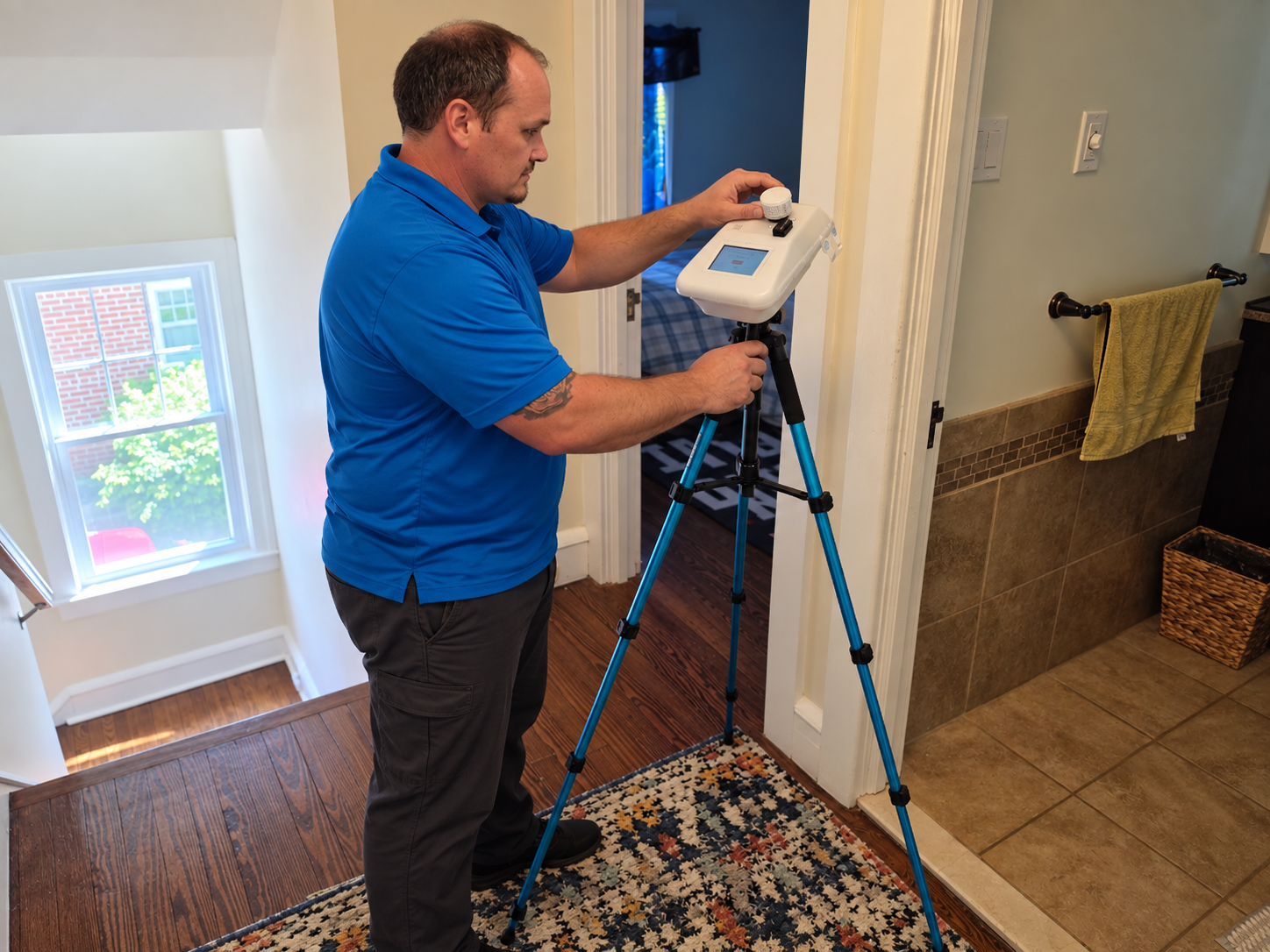
Every test starts with an outdoor control sample, because a particle count only means something in comparison to the air outside the building that day. Then we sample the rooms in question. An accredited laboratory identifies each particle type, counts it per cubic meter, and returns a determination for every room: CLEAR, MODERATE, or POOR. You get a signed certificate of analysis with a full glossary explaining every particle found, where it comes from, and what it means.
How It Works
Tell Us What You're Experiencing
Symptoms, odors, dust, a recent renovation, a room that always feels wrong. It tells us where to sample.
We Collect the Samples
An outdoor control plus air samples from the areas of concern, taken under laboratory protocol.
You Get the Analysis
A certificate of analysis with determinations by room, particle counts, and a glossary — plus practical next steps for whatever turned up.
IAQ Testing or Mold Testing?
Indoor Air Quality Testing — $300
Identifies over 30 particulate types in your air: pollen, pet dander, fiberglass, soot, ash, insect debris, mineral dust, cellulose fibers, skin cells, and more. IAQ testing will indicate whether mold is present, but it does not identify what type of mold it is or how much. Order this when: mold and radon came back clean and the symptoms didn't. Or when the concern is dust, odors, allergies, pets, or a recent renovation.
Mold Testing — $285
Identifies the specific mold types present, with spore counts per cubic meter and a normal-or-problem determination for each room sampled. Order this when: there's visible growth, a musty smell, a past leak, water damage, or a previous remediation.
View Mold TestingNot Sure? Add IAQ to a Mold Inspection.
If you want both answers — which molds are present and what else is in the air — IAQ testing can be added to a mold inspection for $300.
What the Particles Tell You
Fiberglass
A few counts are normal. A lot can mean a breach in fiberglass ductwork, a filter coming apart, or degrading ceiling tiles. Irritating to eyes, skin, nose, and throat.
Pollen
Should be far lower inside than outside. When it isn't, your filtration or your ventilation habits are the reason.
Soot
Comes from incomplete combustion: candles, fireplaces, gas appliances, traffic. Elevated indoor soot points at a source worth finding.
Skin Cells
Normal indoors, and usually the most abundant particle. A high concentration can indicate a significant dust mite population, whose droppings are a common allergen.
Mineral Dust
Should always read lower inside than outside. Higher indoors suggests it's being generated or tracked in — construction, unsealed crawlspace, failing ductwork.
Insect Fragments
Low counts are ordinary. High counts can indicate an infestation or a filtration system that isn't doing its job.
Honest Limits
- It doesn't identify mold types. IAQ testing indicates whether mold is present. Identifying which mold and at what concentration requires mold testing.
- No federal standard exists for indoor particulate concentrations. Determinations are based on comparison to the outdoor control and typical background levels for living areas.
- This is not a medical assessment. We report what's in the air. What it means for a specific person is a conversation with their physician.
- It's a snapshot. Results describe the air sampled in those locations, on that day, under those conditions.
- It doesn't test for gases. Radon, carbon monoxide, and VOCs are separate tests.
- Mitigation is your choice. The report tells you what's there and what typically causes it. What you do about it is up to you.
Nobody Gets a Second Opinion on Their Own House
Most people with an air quality problem never identify it. They rearrange their lives around it instead — running purifiers, replacing furniture, blaming the season, taking allergy medication year-round, assuming this is just how they feel now.
Some move. Some spend thousands chasing mold that was never there.
The test costs a fraction of any of that, and it usually points at something you can fix in a weekend.
What You'll Walk Away With
Laboratory identification of what's actually in your air, room by room, with a determination you don't have to interpret. An explanation of where each particle type comes from. And in most cases, a specific and affordable thing to change.
Frequently Asked Questions
Related Services
Stop Guessing at the Air You Breathe
$300, added to a home inspection or a mold inspection. Pricing is subject to change based on the size of the home, number of samples, property conditions, and location.
Vivid Home Inspections proudly serves homebuyers and homeowners throughout South Jersey, including Camden, Burlington, and Gloucester Counties, as well as Eastern Pennsylvania.
Client Reviews
What Our Clients Say
Real reviews from real home buyers and sellers across South Jersey and Eastern Pennsylvania.
Home Inspections Across South Jersey & Eastern PA
We proudly serve home buyers, sellers, and owners throughout South Jersey and Eastern Pennsylvania. Local expertise means we know the common issues in regional construction, soil, and aging housing stock.
- Burlington County
- Camden County
- Gloucester County
- Salem County
- Mercer County
- Eastern Pennsylvania
Ready for a Vivid, Detailed Home Inspection?
Book online in minutes or call us directly. Certified inspectors, same-day digital reports, and coverage across all of South Jersey and Eastern Pennsylvania — so you can move forward with confidence.
Certified & Insured
InterNACHI certified, NJ licensed & insured.
Same-Day Reports
Detailed, photo-rich findings within 24 hours.
Easy Online Booking
Schedule your inspection in minutes.
Talk to a Real Person
Mon–Fri: 7:00 AM – 6:00 PM | Sat: 8:00 AM – 4:00 PM